

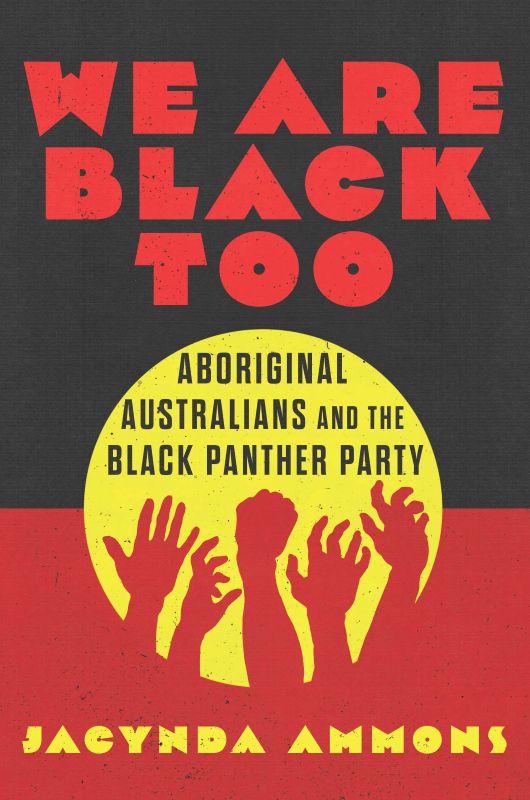
National Park College’s (NPC) Jacynda Ammons, Ph.D., academic program director of liberal arts and assistant professor of history, has authored a new book, We Are Black, Too: Aboriginal Australians and the Black Panther Party, an expansive study of 20th‑century connections between African Americans and Aboriginal Australians rooted in shared resistance to racism and colonialism.
The book will be released April 7, 2026, by the University of Oklahoma Press as part of its Greenwood Cultural Center Series in African Diaspora History and Culture.
Ammons said the title derives from a declaration made by an Aboriginal Australian activist who, in seeking strategies to combat oppression at home, identified in solidarity with African Americans and described Aboriginal Australians as “black too.”
“If there’s one idea I hope readers carry with them, it’s that we are all alike in the things that matter,” Ammons said. “We all want freedom, equality and the ability to take care of ourselves and others. If we kept that in mind and worked together, we could make the world a little better for everyone.”
We Are Black, Too traces the lasting influence of African American activism on Aboriginal political movements, beginning with Marcus Garvey and progressing through the Civil Rights Movement and Black Power era. The book examines events such as Australia’s Freedom Rides and the 1970 Congress of African Peoples in Atlanta, where Aboriginal activists engaged directly with leaders in global Black liberation movements.
Ammons places particular emphasis on the Black Panther Party, explaining how its ideas resonated internationally.
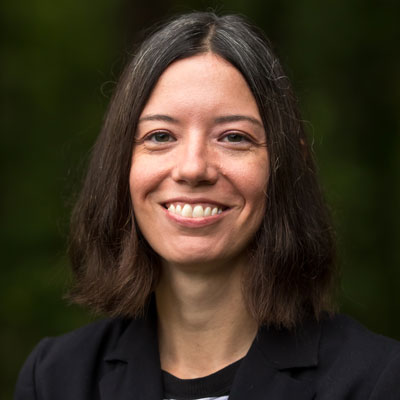
“My goal is to demystify the Black Panther Party in the United States so readers can understand why people on the other side of the world would be interested,” she said. “Ideas about ending white supremacy, imperialism and colonialism inspired many different communities.”
The book explores the expansion of Black Panther politics beyond the United States, noting that while the party established an International Section in Algeria in 1971, an Australian chapter emerged later following internal shifts within the U.S. organization. Ammons situates Aboriginal activism within a broader analysis of transnational Black identity and the global Black diaspora, offering insight into how international solidarity shaped movements for justice and self‑determination.
Ammons’ research was supported by a fellowship from Texas Tech University and involved extensive archival work in both Australia and the United States. Her research sites included the National Archives of Australia, the Australian Institute of Aboriginal and Torres Strait Islander Studies, and the National Film and Sound Archive in Canberra. In the United States, she conducted research in the Huey P. Newton Papers at Stanford University and the Eldridge Cleaver Papers at the University of California, Berkeley.
“Finding correspondence between the U.S. and Australia in the Newton papers proved the connections I was searching for,” Ammons said. “It was the moment everything came together.”
A peer‑reviewed article drawn from the project and published in The International Journal of Africana Studies helped re‑energize Ammons to complete the full manuscript.
“Having encouragement from someone in my field helped me get out of my own way and finish,” she said.
Although the project began before her time at NPC, Ammons said the campus environment played a key role in bringing the work to completion.
“If you saw me in the Commons or Starbucks the last couple of years, I was probably working on the book,” she said. “The Commons became my quiet place to focus while still being energized by our campus community.”
She also credited Amanda Kruzel, assistant professor of sociology at NPC, for consistent encouragement and for promoting student engagement with the book’s themes.
“Amanda has been telling her classes about the book and encouraging curiosity about stories we don’t often hear,” Ammons said. “I’m grateful for her support and for helping students engage with the material.”
Ammons said the book is intended primarily for students, educators and scholars, but she hopes it will also resonate with general readers interested in global social movements and international activism.
“No one goes to an academic press to make money,” she said. “It’s about legitimacy in your field and honoring the research. I wanted to share an important story in a bigger way than conference presentations or a single article could reach.”
Ultimately, Ammons hopes the book will inspire future scholars.
“If one student somewhere reads it and decides to go to graduate school, get a Ph.D., and expand on what this book has started, that would mean everything to me,” she said.
NPC will host a book‑release reception for We Are Black, Too on April 16 from 3 to 5 p.m. in the Student Commons, Room CO‑268. Ammons will be doing a presentation on the book starting at 3 p.m. with discussion and refreshments to follow, and the campus community is invited to attend.
Looking ahead, Ammons is considering a local history project for the Arkansas Historical Quarterly examining segregation in the former company town of Mountain Pine, including connections to Dierks Lumber and Weyerhaeuser.
“We’re reaching a point where many who lived that history are passing away,” Ammons said. “It’s important to document those stories now.”
We Are Black, Too will be available beginning April 7 through the University of Oklahoma Press and major booksellers.